What CoolWallet Pro actually is (and is not)
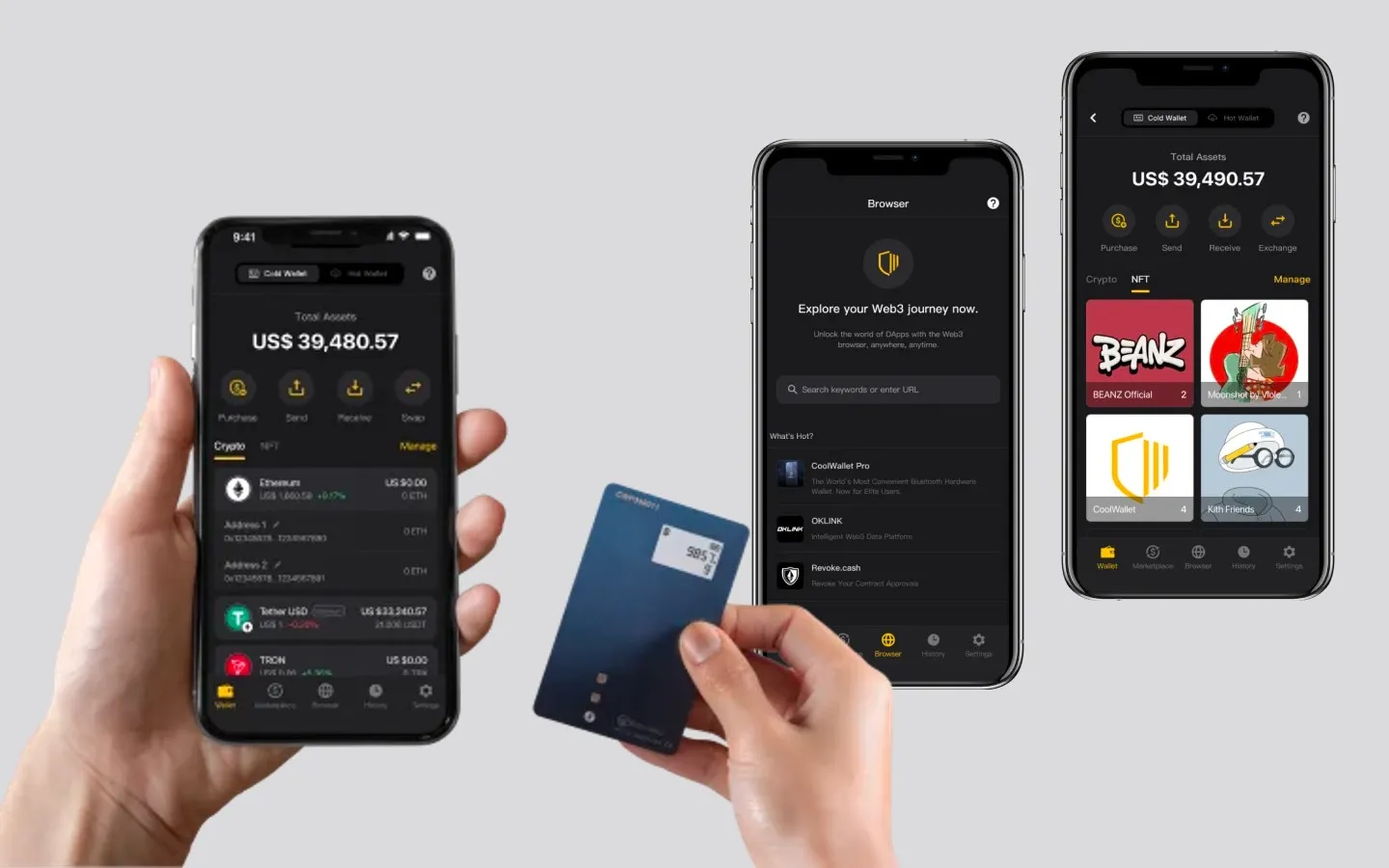
CoolWallet Pro is a hardware wallet shaped like a credit card. Not "roughly card-sized" the way some marketing departments stretch the truth — it measures 85.6 × 53.98 × 0.8 mm and weighs about 6 grams, according to the official coolwallet.io site (July 2026). It slides into the same slot in your physical wallet where your debit card lives. That single design decision explains almost everything else about the device: the e-paper screen, the tiny battery, the Bluetooth-only connection, and most of its genuine limitations.
Inside the laminated body sits a CC EAL6+ certified secure element. That is the chip where your private keys are generated and where they stay. They never leave it — not to your phone, not to CoolBitX servers, not anywhere. When you sign a transaction, the transaction data goes into the chip, the signature comes out, and the key never moves. This is the whole point of a hardware wallet, and CoolWallet Pro does it with one of the highest security certifications available in a consumer device.
What CoolWallet Pro is not: it is not an exchange, not an account you register for, and not something you can "log into" with an email and password. If you have ever seen a website offering a CoolWallet login form, you were looking at a phishing page — I explain why in detail on the login and sign-up page. It is also not a desktop tool. There is no desktop app and no browser extension, full stop. If that surprises you, read it again, because it is the number one complaint from power users and the number one thing the sales pages gloss over.
Who is CoolBitX, and why should you care?
CoolWallet is made by CoolBitX, a blockchain security company headquartered in Taipei, Taiwan, founded in 2014. The first CoolWallet shipped in 2016 — which makes it one of the oldest hardware wallet lines still in production, older than most people realize. The CoolWallet S arrived in the 2018 era, the Pro launched in 2021, the app gained a Hot Wallet mode, and the NFC-based CoolWallet Go joined the family in the 2024 era.
Why does the company behind the device matter? Because with a hardware wallet you are trusting a supply chain, a firmware team, and a support organization for years. A wallet from a company that vanishes in eighteen months leaves you with an unsupported brick and a migration headache. CoolBitX has been shipping hardware for a decade, claims over 300,000 users worldwide, and — per its official statements — has had zero confirmed remote hacks of the secure element to date. I treat vendor security claims with professional skepticism, but a decade without a confirmed SE breach is a track record, not a promise.
The Taiwan angle is more than trivia. Taiwan is where a large share of the world's secure chips are designed and fabricated, and CoolBitX builds and certifies its flagship at home — the Pro carries Taiwan NCC certification (NCC ID CCAF22LP0650T3) alongside CE and RoHS. If supply-chain trust matters to you — and after the last few years of tampered-device scams, it should — the Taiwan guide covers why the home market matters and how to buy from the official Taiwanese store from abroad.
Pro vs Go vs S vs the app: the lineup at a glance
CoolBitX sells three physical cards and one app, and the naming does not make the differences obvious. Here is the honest version, with prices from the official coolwallet.io site as of July 2026:
| Product | Price | Secure element | Screen | Connection | Best for |
|---|---|---|---|---|---|
| CoolWallet Pro | NT$4,679 (~US$149 internationally) | CC EAL6+ | E-paper + button | Encrypted Bluetooth | Main cold storage, staking, 30+ chains |
| CoolWallet Go | NT$2,167 (~US$69–79) | Secure element, NFC | None | NFC tap-to-sign | Beginners, cheap cold backup |
| CoolWallet S | Often discounted | CC EAL5+ | E-paper + button | Encrypted Bluetooth | Legacy users; being phased down |
| CoolWallet App | Free | None (phone storage) | Your phone | — | Hot wallet for small amounts |
The Pro is the flagship: CC EAL6+ chip, support for 30+ blockchains and 12,000+ tokens, in-app staking for ATOM, SOL and XTZ, and an e-paper display on the card itself so you can verify what you are signing on the device, not just on the phone. The Go strips out the battery, the Bluetooth and the screen; it is powered by your phone's NFC field and signs with a tap. That makes it cheaper and maintenance-free, but you lose on-card verification — confirmations happen on the phone screen, which is a real security trade-off, not a cosmetic one. The S is the 2018-era classic with a CC EAL5+ chip and fewer supported chains; buy it only at a steep discount, and read the disadvantages page before you do.
Why the credit-card format actually matters
It is easy to dismiss the card shape as a gimmick. I did, in 2018. Then I watched how people actually fail at self-custody, and I changed my mind. The most common hardware wallet failure I see is not a hack — it is a device that lives in a drawer, unused, while the owner keeps everything on an exchange "just for now". A wallet you carry is a wallet you use.
The Pro is waterproof enough for daily carry, bend-resistant, and tamper-evident thanks to its laminated construction — you cannot open the card without visibly destroying it, which makes physical implant attacks far harder than on screw-together plastic devices. The rechargeable battery (3 V / 15 mAh lithium-ion) charges in about two hours in its proprietary sleeve and runs roughly two weeks of typical use — around two transactions a day — or up to three months on standby, per official figures.
There are downsides to the format, and I will not hide them: the e-paper screen is small and shows limited transaction detail compared with the big screens on a Trezor Safe 5 or Ledger Flex, and if you lose the proprietary charging sleeve, replacing it is an annoyance. The full accounting lives on the honest cons page. But as a piece of security engineering aimed at the way normal humans actually live, the card format has earned my respect.
Keep the safe, use the bank wisely
Cold storage for savings, a regulated exchange for the on- and off-ramp — that split has protected my funds through every cycle since 2017. If you still need the exchange side, pick one with a long security track record.
Open a secure exchange accountThe security model in plain words: bank vs personal safe
Before you buy any hardware wallet, you need to understand one distinction, because everything else follows from it. There are two ways to hold cryptocurrency: custodial and non-custodial.
Custodial means someone else holds the keys for you. An exchange account is custodial. Think of it as a bank: convenient, familiar, password resets when you forget things — but the assets sit in their vault, under their rules. If the bank freezes withdrawals, gets hacked, or goes bankrupt, your access goes with it. Crypto history is a graveyard of custodians that were "totally safe" until the morning they were not.
Non-custodial means you hold the keys. A CoolWallet is a personal safe: nobody can freeze it, nobody can confiscate what is inside by pressing a button in an office somewhere — and nobody can open it for you if you lose the combination. The combination, in this world, is your seed phrase: 12, 18 or 24 words generated inside the secure element when you set the wallet up. Whoever has those words has your money. There is no reset email. No support agent can recover them — and anyone who claims they can is running a scam.
⚠ The seed phrase is the wallet. The card is replaceable; the words are not. Write them on the two recovery cards included in the box, store them offline in two separate places, and never type them into any website, app, or "validation" form. Every seed-entry prompt outside your own wallet's recovery flow is theft in progress.
The bank-vs-safe analogy also explains what a hardware wallet cannot do. A safe does not stop you from voluntarily handing over the combination to a con artist. Most crypto losses in 2026 are not hacks of secure chips — they are people signing malicious transactions or surrendering their seed to phishing pages. The device protects the keys; your habits protect everything else. That is why half this site is about habits.
What this site covers — the full map
This is an independent guide, written from the perspective of someone who audits these systems for a living and has watched every hype cycle since 2017. Every page assumes you want the truth, including the inconvenient parts. Here is the map:
- CoolWallet as a cold wallet — what cold storage actually means, how the CC EAL6+ secure element works in plain language, and when cold storage is overkill.
- App download guide — where to get the genuine app (App Store and Google Play only), why there is no official APK or desktop version, and how to spot fake apps before they empty your wallet.
- Login and sign-up explained — spoiler: there is no login, and understanding why will protect you from an entire category of phishing.
- CoolWallet Pro tutorial — the full setup, step by step, from tamper-checking the box to your first verified transaction and staking.
- Disadvantages — every real con, its practical impact, and how it compares with Ledger, Trezor and Tangem.
- Discount codes — how official discounts really work and why most coupon sites are dead codes or outright phishing.
- CoolWallet Pro in Taiwan — the home-market story, NCC certification, and ordering from the official Taiwanese store.
- Hot Wallet mode — the app's software wallet side, when it is fine and when it is reckless.
Nothing here is financial advice, and I will never tell you what to buy as an investment. I will tell you how to keep whatever you do buy out of other people's hands.
The short version of the cons (yes, on the home page)
Most review sites bury the negatives below eight paragraphs of affiliate enthusiasm. I would rather you see them before you spend a cent. CoolWallet Pro costs more than basic USB hardware wallets. It is mobile-only — no desktop app, no browser extension, which makes heavy desktop dApp use awkward and pushes you toward WalletConnect workarounds. The firmware is closed-source, unlike Trezor's fully open approach, so you are trusting CoolBitX's audits rather than the community's eyes. The battery needs periodic recharging in a proprietary sleeve. The small e-paper display shows less transaction detail than big-screen competitors. Portfolio sync can crawl if you hold many assets, and some newer coins and features land on Ledger or Trezor first.
Bluetooth deserves its own sentence, because critics love it: yes, wireless is an attack surface in theory. In practice the traffic is end-to-end encrypted and all signing happens inside the secure element, so a compromised Bluetooth link gets an attacker exactly nothing they can use. Security purists who want a fully air-gapped device are right to want one — they are just describing a different product. Every one of these points is expanded, with mitigations, on the disadvantages page.
Rule of thumb from a decade of audits: any review that lists zero disadvantages is an advertisement. That applies to this site too — hold me to it.
Who should buy what: the verdict
After putting the lineup through real daily use, here is my honest matching of product to person.
Buy the CoolWallet Pro if you hold meaningful value across multiple chains, you live on your phone rather than a desktop, and you want staking (ATOM, SOL, XTZ natively) without handing coins to a custodian. The on-card e-paper verification is the feature that earns it the flagship badge — you confirm the actual address and amount on hardware a malware-infected phone cannot alter. Start with the step-by-step tutorial and send a small test amount first. Always a small test amount first.
Buy the CoolWallet Go if you are new to self-custody, hold modest amounts, or want an inexpensive second cold wallet as a backup location. Accept its trade-off with open eyes: no screen means the phone displays what you are signing, so it protects your keys brilliantly but verifies transactions less independently than the Pro.
Skip the CoolWallet S unless you find it heavily discounted and your coins are on its shorter supported list. It is the past; the Pro is the present.
Use the free app's hot mode for pocket money and dApp experiments only — the hot wallet page draws the line in detail. And if your entire crypto holding is small enough that losing it would sting less than US$149, a hardware wallet may genuinely be overkill for now; there is no shame in that. The point of self-custody is matching the tool to the stakes — not buying gadgets.
Frequently asked questions
Is CoolWallet Pro safe in 2026?
Its private keys live in a CC EAL6+ certified secure element and never leave the chip, and CoolBitX reports zero confirmed remote hacks of the secure element to date. No device makes you immune to phishing or seed-phrase theft, though — most real-world losses come from user-side scams, not chip failures, so safe habits matter as much as the hardware.
What is the difference between CoolWallet Pro and CoolWallet Go?
The Pro (NT$4,679, ~US$149) has a CC EAL6+ chip, Bluetooth, a battery and an e-paper screen for on-card transaction verification, plus staking and 30+ chains. The Go (NT$2,167, ~US$69–79) is a screen-less NFC card powered by your phone — cheaper and maintenance-free, but you confirm transactions on the phone instead of on the card.
Does CoolWallet have a desktop app or browser extension?
No. CoolWallet is mobile-only: the official app exists for iOS 15.6+ and Android 7.0+ and connects to the card via encrypted Bluetooth or NFC. There is no desktop application and no browser extension. Desktop dApp users typically bridge through WalletConnect, which works but is less convenient than a native extension.
Who makes CoolWallet?
CoolBitX, a blockchain security company founded in 2014 and headquartered in Taipei, Taiwan. It shipped the first CoolWallet in 2016, the S in the 2018 era, the Pro in 2021 and the NFC-based Go in the 2024 era, and claims more than 300,000 users worldwide according to its official site.
Do I need an account or KYC to use CoolWallet?
No. CoolWallet is non-custodial: there is no email, no password, no registration and no identity check. Access is your device plus PIN or biometrics, and recovery is your seed phrase alone. That also means nobody can reset anything for you — guard the seed phrase accordingly.
How much does CoolWallet Pro cost?
According to the official coolwallet.io site (July 2026), the Pro costs NT$4,679 on the Taiwanese store, and international listings run around US$149. The entry-level Go is NT$2,167 (roughly US$69–79 internationally). Buy only from the official store or official marketplace listings — second-hand devices carry a tampering risk that no discount justifies.